
Eleven Years in the Making: Weihao Chen becomes Miami’s first Engineering doctoral graduate
Chen crossed the finish line in December 2025, becoming the first graduate of the new Engineering doctorate program
•
Published
•
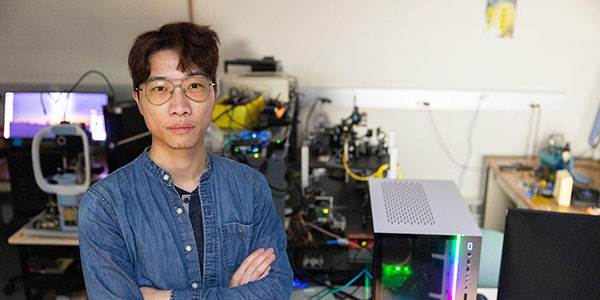
Weihao Chen became the first graduate of the new Engineering doctorate program in January.
Eleven Years in the Making: Weihao Chen becomes Miami’s first Engineering doctoral graduate
Chen crossed the finish line in December 2025, becoming the first graduate of the new Engineering doctorate program
•
Published
•
When Weihao Chen ’18, M.S.’21, Ph.D.’25 arrived at Miami University in 2014, the doctoral program he wanted didn’t exist. Eleven years later, he became the first graduate of Miami’s new interdisciplinary Engineering doctorate program.
Chen described his path into the field of biomedical engineering as serendipitous. Growing up, he had vision issues resulting from amblyopia — commonly known as a “lazy eye.” Frequent doctor visits during his childhood influenced him to pursue a career where he could help restore people’s vision. This childhood ambition was also his driving force for joining the BioPhotonic Lab of Hui Wang, associate professor of Chemical, Paper, and Biomedical Engineering, in 2017.
Wang’s BioPhotonic lab specializes in advanced research and development for Optical Coherence Tomography (OCT), a biomedical imaging technique that utilizes light waves to non-invasively obtain images from organs like the eye, skin, heart, or esophagus. OCT has been widely adapted as the standard diagnosis technique for cancer diagnosis and many ophthalmological diseases, including glaucoma, retinopathy, and age-related macular degeneration (AMD). The goal of Wang’s research is to advance OCT imaging technology in fundamental and transitional research, as well as technical development for future clinical application including ophthalmology.
Chen’s role in the lab was to create a multi-modal OCT system combining OCT with fluorescence microscopy, an imaging modality that illuminates fluorescent cells in transgenic animal models like newts and zebrafish, allowing researchers to observe specific cellular activity during biological processes. This multi-modal OCT imaging platform was used to track the regeneration process of newt lenses in vivo for the first time.
Chen’s educational journey to his doctoral degree was anything but straightforward. When he graduated with a bachelor’s degree in Bioinformatics and Computer Science in 2018, a doctoral program in Engineering didn’t exist yet. He finished his master’s in Chemical Engineering then joined the Cell, Molecular, and Structural Biology (CMSB) graduate program so he could continue his research with Wang. A Ph.D. in Engineering “was always what I wanted to do, but it was never an option at Miami,” Chen said.
When the Engineering doctorate program was made available to students in fall 2025, the process to transfer to the new program was a whirlwind for Chen. From September to December, Chen juggled numerous experiments, qualifying exams, proposals, and a dissertation — all while taking care of a 1½-year-old son with his wife, Mengyang “Flora” Xu, who received her Ph.D. in CMSB in summer 2025, with adviser Haifei Shi.
“It was stressful, but fruitful at the same time. ‘Love and Honor’ couldn’t be more appropriate to summarize my journey at Miami,” Chen said.
Chen said he was honored to be the first graduate of the program and grateful for all those who supported him along the way, including Wang, who served as his doctoral advisor, associate dean for Graduate Studies Marnie Saunders, as well as professor of Biology Katia Del Rio-Tsonis and assistant professor of Biology Mark Charlton-Perkins, whom Chen collaborated closely with. Chen’s work was mostly supported by National Institutes of Health, U.S. Department of Defense grants, and Miami internal research grants. As more students join the program, he hopes more funds can be raised for research labs which would nourish next generation graduate talents.
“Weihao is a true pioneer for our department and the college,” Wang said. “As an international student, his ability to immediately secure an industry position is a massive testament to his dedication, his talent, and the rigorous training he undertook in our team. He has published multiple journal papers and presented at several international conferences. His achievements have come to define the caliber of the College of Engineering and Computing Ph.D. program.”
Chen will be one of the founding research scientists at Imagen Bioworks, a biotechnology research startup focused on developing autonomous microscopic technology, in Houston. Their research could advance studies for neuroscience and cancer treatment, work that Chen said he’s excited to be part of.
Chen described his path into the field of biomedical engineering as serendipitous. Growing up, he had vision issues resulting from amblyopia — commonly known as a “lazy eye.” Frequent doctor visits during his childhood influenced him to pursue a career where he could help restore people’s vision. This childhood ambition was also his driving force for joining the BioPhotonic Lab of Hui Wang, associate professor of Chemical, Paper, and Biomedical Engineering, in 2017.
Wang’s BioPhotonic lab specializes in advanced research and development for Optical Coherence Tomography (OCT), a biomedical imaging technique that utilizes light waves to non-invasively obtain images from organs like the eye, skin, heart, or esophagus. OCT has been widely adapted as the standard diagnosis technique for cancer diagnosis and many ophthalmological diseases, including glaucoma, retinopathy, and age-related macular degeneration (AMD). The goal of Wang’s research is to advance OCT imaging technology in fundamental and transitional research, as well as technical development for future clinical application including ophthalmology.
Chen’s role in the lab was to create a multi-modal OCT system combining OCT with fluorescence microscopy, an imaging modality that illuminates fluorescent cells in transgenic animal models like newts and zebrafish, allowing researchers to observe specific cellular activity during biological processes. This multi-modal OCT imaging platform was used to track the regeneration process of newt lenses in vivo for the first time.
Chen’s educational journey to his doctoral degree was anything but straightforward. When he graduated with a bachelor’s degree in Bioinformatics and Computer Science in 2018, a doctoral program in Engineering didn’t exist yet. He finished his master’s in Chemical Engineering then joined the Cell, Molecular, and Structural Biology (CMSB) graduate program so he could continue his research with Wang. A Ph.D. in Engineering “was always what I wanted to do, but it was never an option at Miami,” Chen said.
When the Engineering doctorate program was made available to students in fall 2025, the process to transfer to the new program was a whirlwind for Chen. From September to December, Chen juggled numerous experiments, qualifying exams, proposals, and a dissertation — all while taking care of a 1½-year-old son with his wife, Mengyang “Flora” Xu, who received her Ph.D. in CMSB in summer 2025, with adviser Haifei Shi.
“It was stressful, but fruitful at the same time. ‘Love and Honor’ couldn’t be more appropriate to summarize my journey at Miami,” Chen said.
Chen said he was honored to be the first graduate of the program and grateful for all those who supported him along the way, including Wang, who served as his doctoral advisor, associate dean for Graduate Studies Marnie Saunders, as well as professor of Biology Katia Del Rio-Tsonis and assistant professor of Biology Mark Charlton-Perkins, whom Chen collaborated closely with. Chen’s work was mostly supported by National Institutes of Health, U.S. Department of Defense grants, and Miami internal research grants. As more students join the program, he hopes more funds can be raised for research labs which would nourish next generation graduate talents.
“Weihao is a true pioneer for our department and the college,” Wang said. “As an international student, his ability to immediately secure an industry position is a massive testament to his dedication, his talent, and the rigorous training he undertook in our team. He has published multiple journal papers and presented at several international conferences. His achievements have come to define the caliber of the College of Engineering and Computing Ph.D. program.”
Chen will be one of the founding research scientists at Imagen Bioworks, a biotechnology research startup focused on developing autonomous microscopic technology, in Houston. Their research could advance studies for neuroscience and cancer treatment, work that Chen said he’s excited to be part of.
Established in 1809, Miami University is located in Oxford, Ohio, with regional campuses in Hamilton and Middletown, a learning center in West Chester, and a European study center in Luxembourg. Interested in learning more about the College of Engineering and Computing? Visit the website for more information.